

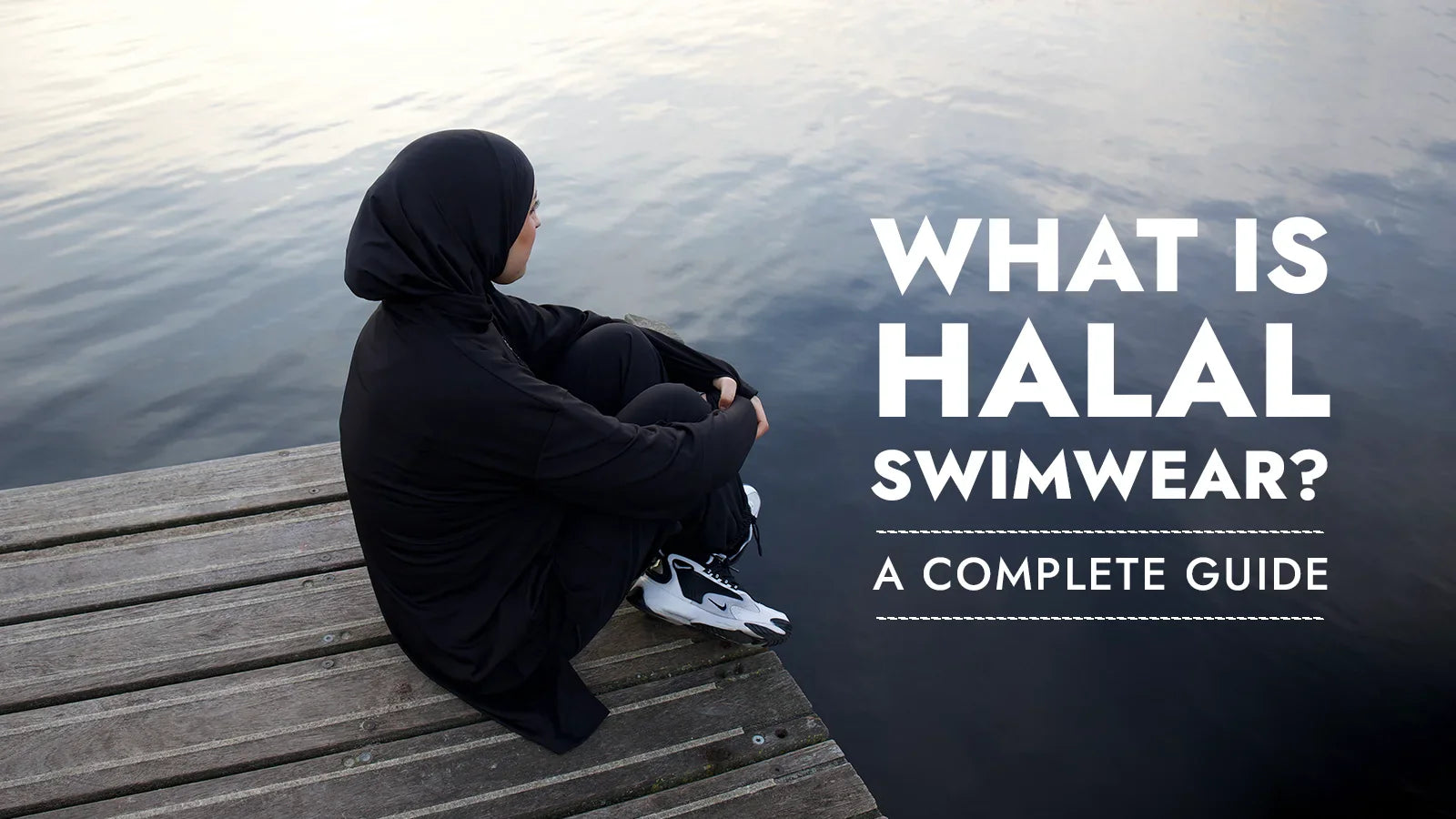
For many Muslims, summer brings a familiar tension. The beach is calling, the pool is full, and the family is ready — but finding swimwear that genuinely aligns with Islamic principles has always been a struggle. Too often, the options are either impractical or simply don't exist.
That's exactly why halal swimwear exists. And if you've landed here wondering what it actually means — whether it's a marketing term or something grounded in Islamic scholarship — you're in the right place.
This guide covers everything you need to know: what halal swimwear is, the Islamic reasoning behind it, how it differs for men and women, and what to actually look for when you're buying.
What does "Halal" mean in the context of swimwear?
The word halal (حلال) simply means "permissible" in Arabic. In Islamic jurisprudence, it refers to anything that is allowed under Shariah law — food, finance, conduct, and yes, clothing as well.
When swimwear is described as halal, it means it meets the Islamic requirements for covering the awrah (the parts of the body that must be kept covered in front of others). It is swimwear designed specifically to allow Muslims to swim, exercise, and enjoy water activities without compromising their religious obligations.
It is not a fashion trend or a marketing gimmick. It is a practical solution to a genuine need that has existed for centuries but has only recently had proper clothing designed around it.
What is the awrah, and why does it matter for swimwear?
To understand halal swimwear, you first need to understand the concept of awrah.
In Islam, the awrah refers to the intimate parts of the body that must be covered in the presence of others. The specific boundaries differ slightly between men and women, and between different scholarly opinions, but the core principles are well established.
For men, the scholarly consensus across the major schools of Islamic law is that the awrah is the area between the navel and the knees. This means that a man swimming in standard Western swimwear — a pair of tight, short swimming trunks that expose the thighs — is not adequately covering his awrah.
For women, the awrah in front of non-mahram men is the entire body except the face and hands. This means that a woman swimming in a standard bikini or one-piece swimsuit is exposing far more than is permitted.
Standard Western swimwear was designed around aesthetics and hydrodynamics, not around religious modesty requirements. This is where our halal swimwear fills the gap.
If you want to learn more about how to cover your awrah properly, refer to this page > Covering our Awrah as Muslims: What are the differences between men and women?
What makes swimwear halal? The key requirements
There are four core characteristics that make swimwear halal. These apply to whether you are buying for a man or a woman.
1. Adequate coverage of the awrah
This is the foundational requirement. The swimwear must cover the parts of the body that need to be covered, as described above. For men, this means no exposed thighs. For women, it means full-body coverage that includes arms and legs.
2. Non-form-fitting fit
Islamic guidelines on modesty require that clothing not cling to the body in a way that reveals its shape. Tight, body-contouring swimwear — even if it technically covers the right areas — does not meet the spirit of the requirement. Halal swimwear is designed with a loose, relaxed fit that conceals the silhouette.
3. Non-transparent fabric
A covering that becomes see-through when wet offers no real modesty. Halal swimwear uses opaque, water-resistant fabrics that maintain their coverage whether you are in or out of the water.
4. No exposure of skin through stretch
Lightweight stretch fabrics that gap or pull when moving can inadvertently expose skin. Good halal swimwear accounts for movement — swimming strokes, bending, reaching — and stays in place throughout.
Halal swimwear for men: What to look for?
For Muslim men, the awrah requirement is relatively straightforward: cover from the navel to the knees. The challenge is that almost no conventional swimwear does this properly.
Standard swim shorts tend to sit at or above the knee, often expose the navel when moving, and are cut close to the body. Even "board shorts" often fall short of genuine awrah coverage.
Truly halal swim shorts for men should:
- Extend well below the knee — not just to the knee, but past it, to account for movement
- Sit at or above the navel — a drawstring or elasticated waistband that stays up during swimming
- Include an inner lining — a mesh or fabric lining that prevents the shorts from becoming transparent or revealing when wet
- Be made from quick-drying, water-repellent fabric — so they remain comfortable and non-clinging after leaving the water
-
Fit loosely — not compression-style, not form-fitting, but genuinely relaxed through the seat and thighs
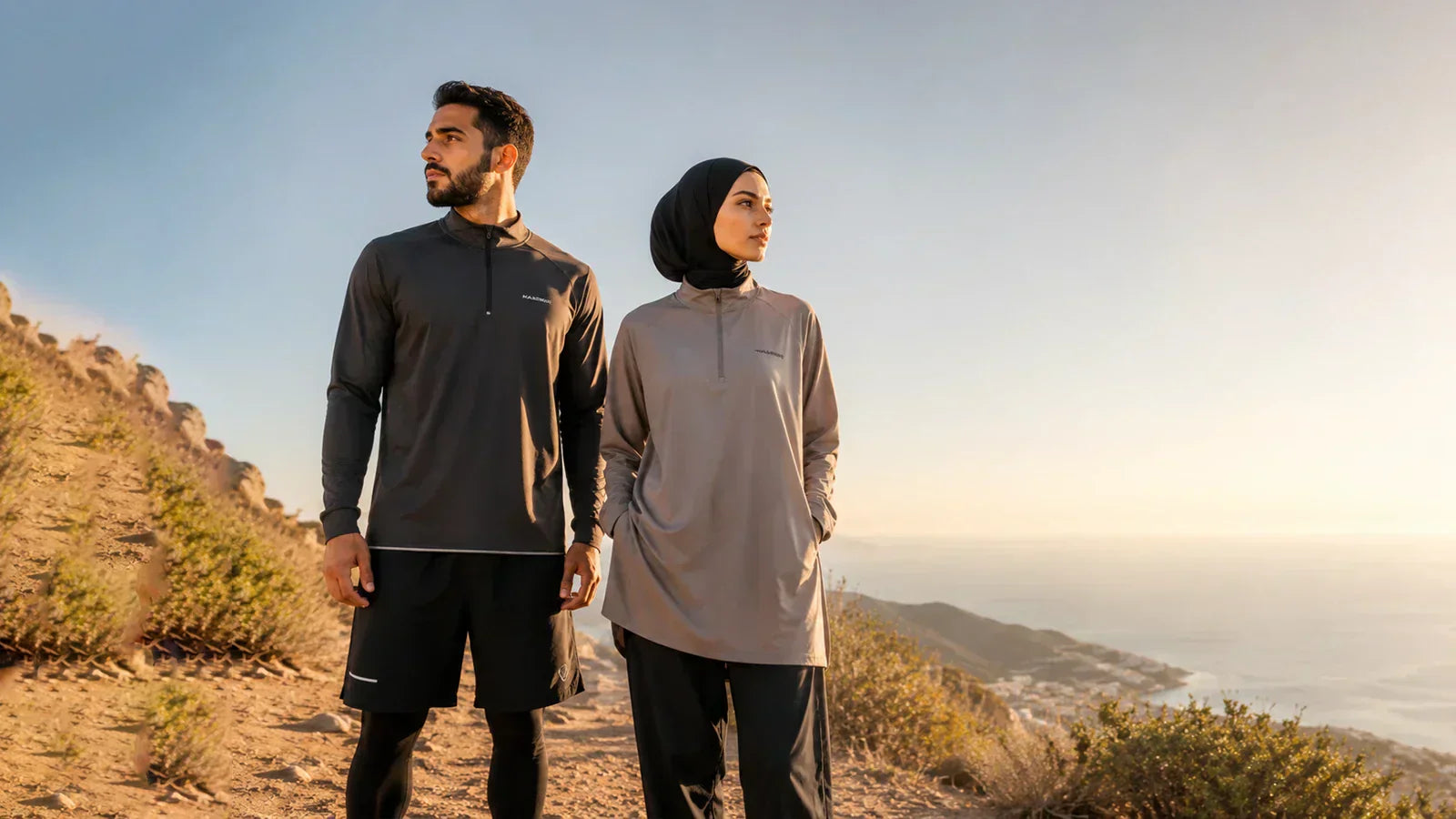
At Myawrah, our men’s halal swimwear collection is designed with exactly these requirements in mind. The inner lining extends from navel to knee, the outer fabric is water-repellent and quick-drying, and the fit is loose enough to move freely without revealing the body's shape.
Halal swimwear for women: What to look for?
For Muslim women, the requirements are more comprehensive, and finding the right swimwear has historically been even harder.
The ideal halal swimwear for women provides:
- Full arm and leg coverage — long sleeves and full-length leggings or trousers as part of the swimsuit
- A loose, non-form-fitting silhouette — not leggings-tight, but genuinely modest in drape and cut
- Opaque, non-transparent fabric — that holds its coverage wet or dry
- Head coverage compatibility — either a built-in hood or designed to be worn with a swim hijab
- Freedom of movement — so it can be worn for actual swimming, not just wading
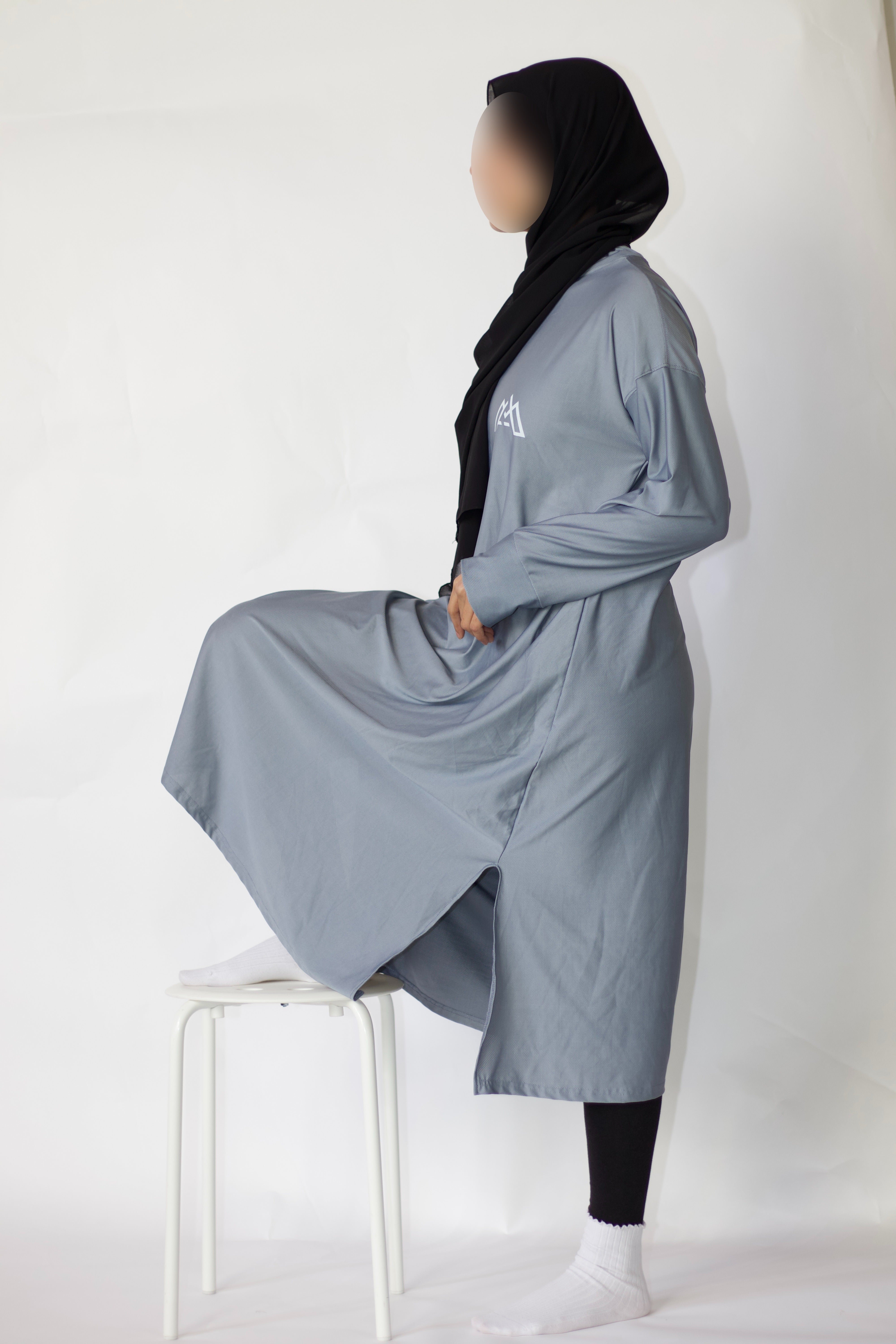
Some women prefer a one-piece modest swimsuit with matching leggings and a swim hijab. Others prefer a sports abaya — a full-length, loose-fitting athletic garment that works both in and out of the water, or at the gym and on the track.
Myawrah's Women's Modest Sports Abaya, for example, is designed in breathable, sweat-wicking fabric that works equally well for swimming, running, or gym use. It is not form-fitting, does not become transparent, and allows full range of motion.
Is halal swimwear the same as a burkini?
You may have heard the term burkini — a portmanteau of burqa and bikini coined in the early 2000s to describe full-coverage swimwear for Muslim women. The burkini gained significant international media attention in 2016 when it was temporarily banned on some French beaches.
Halal swimwear and burkinis overlap considerably, but they are not identical terms.
A burkini refers specifically to a particular style of women's full-coverage swimsuit, typically a three-piece set: a top, trousers, and a hood or cap. Halal swimwear is a broader category that includes burkinis as well as other modest swimwear styles — swim abayas, modest shorts and tops, and men's halal swim shorts.
Not all burkinis are created equal in terms of Islamic compliance. Some are form-fitting or semi-transparent. When evaluating any modest swimwear, the four criteria above — coverage, fit, opacity, and movement integrity — matter more than the label.
Is there a difference of scholarly opinion on what counts as halal swimwear?
Yes — and it is worth being aware of this, particularly for men.
The majority scholarly position is that the awrah for men extends from the navel to the knees, and that the knees themselves should be covered. However, within the Shafi'i and Maliki schools of thought, some scholars hold that the navel and knees themselves are not part of the awrah — the boundary is exclusive of those points rather than inclusive.
This means that some Muslim men may be comfortable with swim shorts that reach to (but not past) the knee, while others will prefer coverage that goes below the knee to be certain.
If you are unsure which scholarly position applies to your practice, consult your local imam or the scholarship of your tradition. What is consistent across all positions is that tight, thigh-exposing conventional swimwear does not meet any mainstream interpretation of halal swimwear requirements
Why is halal swimwear important beyond religious obligation?
For many Muslims, the desire for halal swimwear is not only about religious compliance — it is about inclusion and participation.
Swimming is one of the sports mentioned in authentic hadith. The Prophet Muhammad (peace be upon him) encouraged teaching children to swim. For Muslims who want to swim with their children on holiday, exercise in a public pool, or simply enjoy the sea on a summer afternoon, the absence of appropriate swimwear has historically been a real barrier.
MyAwrah was founded in Tilburg, Netherlands, in 2023 precisely because of this barrier. Growing up, I rarely swam on holidays — not because I did not want to, but because wearing regular trousers and a T-shirt in the pool was impractical and uncomfortable, and there were no purpose-built alternatives that worked. That personal experience is what drove me to create swimwear that actually functions in the water while respecting Islamic principles.
Halal swimwear allows Muslims to participate fully in activities that the rest of the world takes for granted — without having to choose between their faith and their freedom.
The MyAwrah range
At MyAwrah, everything we make is designed around these principles — not as an afterthought, but as the starting point. Our halal swim shorts for men extend from navel to below the knee, include a full mesh inner lining, and are made from lightweight, water-repellent fabric that dries fast and does not cling. Our women's modest activewear is designed to provide full coverage and freedom of movement for swimming, running, gym sessions, and everyday wear.
We ship worldwide, and we offer free shipping within the Netherlands.
Have a question about halal swimwear or Islamic modest clothing? Reach out to us at support@myawrah.com — we are always happy to help.
Share: